
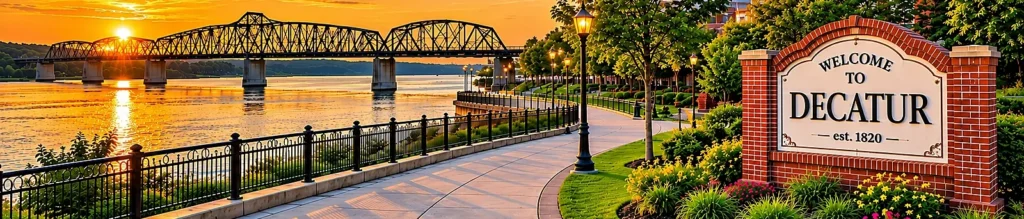
Living in Decatur, Alabama: A Local Guide for Home Buyers
Thinking about moving to Decatur? This guide covers homes, neighborhoods, schools, commute routes, major employers, river recreation, historic districts, nearby communities, and the practical details buyers should understand.
Search Decatur Homes Tell Us About Your MoveDecatur is known as the River City because of its location along the Tennessee River and Wheeler Lake. It has a noticeably different character from Huntsville, Madison, or Athens: more established housing, a strong industrial economy, historic neighborhoods, extensive river access, and a traditional downtown.
The U.S. Census Bureau estimated Decatur’s population at 58,056 in 2025. Census data for 2020–2024 reports an owner-occupied housing rate of 63.3 percent and a median value of $210,200 for owner-occupied homes. Those citywide figures provide context, but individual neighborhoods differ considerably in home age, condition, school zoning, river proximity, and commute access.
After helping families relocate throughout North Alabama for more than 16 years—and after experiencing 11 military moves ourselves—we know buyers are rarely choosing only between houses. They are comparing daily commutes, home maintenance, schools, neighborhood character, city services, and the lifestyle each community supports.
Decatur at a Glance
Approximately 58,056
Primarily Morgan County, with a portion in Limestone County
Established river city with historic and industrial roots
I-65, I-565, Highway 20, Highway 31 and Highway 67
Manufacturing, healthcare, education, aerospace and logistics
Tennessee River, Wheeler Lake, Point Mallard and downtown Decatur
Why People Choose Decatur
What Is It Like to Live in Decatur?
Decatur feels more established and industrial than many of North Alabama’s newer suburban growth areas. The city has traditional neighborhoods, mature landscaping, older brick homes, historic districts, riverfront areas, local restaurants, museums, arts organizations, and a long-standing manufacturing base.
The city is large enough to provide everyday shopping, healthcare, schools, recreation, and community events, but it does not offer the same volume of entertainment or new commercial development as Huntsville. Many residents see that as part of the appeal: Decatur feels like its own city rather than a suburb built around another community.
The Tennessee River is central to Decatur’s identity. Boating, fishing, wildlife, marinas, riverfront events, and parks are more visible in everyday life here than in most other North Alabama cities.
Where Is Decatur, Alabama?
Decatur is located primarily in Morgan County, with a portion extending north of the Tennessee River into Limestone County. Interstate 65 runs east of the city, while I-565 begins near Decatur and connects the area with Huntsville, Madison, Huntsville International Airport, and Redstone Arsenal.
Highway 31 provides access toward Athens and Hartselle, Highway 20 connects industrial areas with I-65 and I-565, and Highway 67 serves major residential and commercial corridors.
This location can work well for people employed in Decatur, along I-65, in Athens, at Mazda Toyota Manufacturing, or in western Madison County. The exact side of Decatur matters: a home near I-65 may offer a very different commute than one farther west or south.
Decatur Homes and Neighborhoods
Decatur’s housing stock is generally more established than what buyers find in the fastest-growing portions of Madison and Limestone counties. The city includes historic homes, mid-century houses, traditional brick ranch homes, two-story homes, townhomes, patio homes, newer subdivisions, waterfront properties, and larger-lot homes outside city limits.
Buyers who value mature trees and established streets may find Decatur appealing. At the same time, older homes can require closer attention to roofing, plumbing, electrical systems, windows, crawlspaces, foundations, drainage, HVAC systems, and prior renovations.
Home values differ significantly according to neighborhood, condition, school zoning, lot size, river proximity, flood-zone status, and renovation quality. Rather than relying on one citywide average, compare homes within the specific areas that fit your commute, maintenance comfort level, and lifestyle.
Old Decatur and Downtown
Historic architecture, tree-lined streets, older homes, walkable access to local restaurants, cultural venues, and community events.
Albany Historic District
Distinctive historic homes and architectural character. Buyers should consider renovation history, preservation requirements, and ongoing maintenance.
Southeast Decatur
Established residential areas with access to Point Mallard, parks, schools, Highway 67, and routes toward I-65.
Southwest Decatur
A mix of traditional neighborhoods, shopping, restaurants, schools, and access to Beltline Road and other city corridors.
River and Wheeler Lake Areas
Properties with boating access, water views, or proximity to the river. Flood maps, insurance, shoreline rules, and drainage require careful review.
Morgan County Outside the City
Rural settings and larger-lot possibilities, with differences in utilities, schools, road maintenance, emergency services, and city limits.
Jobs and Major Employers
Decatur and Morgan County have one of North Alabama’s strongest manufacturing and industrial employment bases. Major sectors include healthcare, public education, appliance manufacturing, steel, aerospace, chemicals, food production, logistics, and advanced manufacturing.
Large employers include Decatur Morgan Hospital, Decatur City Schools, GE Appliances, Morgan County Schools, Wayne-Sanderson Farms, 3M, Nucor Steel, United Launch Alliance, the City of Decatur, Calhoun Community College, Daikin America, and other industrial operations throughout Morgan County.
This employment mix makes Decatur particularly relevant for buyers who work locally or along I-65. It may also work for some employees in Athens, Limestone County, western Madison County, Mazda Toyota Manufacturing, or Huntsville International Airport.
Location and Commuting From Decatur
Decatur is connected to Huntsville by I-565 and to Athens, Birmingham, Nashville, Hartselle, and Cullman by I-65 and Highway 31. Your actual drive depends heavily on which side of Decatur you live on, where you enter the interstate, road construction, and the location of your workplace.
Local Decatur Employment
Living in Decatur can provide a convenient commute to local plants, downtown, Decatur Morgan Hospital, schools, Beltline Road, and the riverfront industrial corridor.
Athens and Limestone County
I-65 and Highway 31 provide direct access north toward Athens, Calhoun Community College, and other Limestone County destinations.
Madison and West Huntsville
I-565 is the primary route toward Madison, Huntsville International Airport, Mazda Toyota Manufacturing, Research Park, and west Huntsville.
Redstone Arsenal and Central Huntsville
The commute is possible, but traffic, distance, and Arsenal gate location should be tested during normal work hours before purchasing.
Schools and School Zoning in Decatur
Homes within the Decatur City Schools district are generally served by Decatur City Schools. Properties outside the city may be served by Morgan County Schools, Limestone County Schools, Hartselle City Schools, or another nearby system depending on the exact location.
School assignments can change, and real estate listings or third-party websites may contain outdated information. Review the official Decatur City Schools, Morgan County Schools, and Limestone County Schools websites and confirm the assignment for the specific property.
Cost of Living, Property Taxes, and Homeownership Costs
Decatur may offer more home for the budget than some neighborhoods in Madison or Huntsville, particularly for buyers comfortable with established or older housing. That comparison is not universal, however. Renovated historic homes, waterfront properties, and homes in highly desired neighborhoods can command higher prices.
Buyers should compare the full cost of ownership, including property taxes, homeowners insurance, flood insurance where applicable, utilities, HOA dues, commuting expenses, and likely maintenance. Older housing can be affordable to purchase but more expensive to update or maintain.
Properties outside city limits may differ in taxes, utilities, sewer or septic service, garbage collection, road maintenance, zoning, and emergency services. Decatur Utilities provides electricity, natural gas, drinking water, and wastewater services within its service territory, but provider arrangements should be verified for each property.
Shopping, Dining, Healthcare, and Everyday Convenience
Decatur provides a broad range of grocery stores, national retailers, local restaurants, medical offices, fitness centers, and everyday services. Beltline Road is the city’s primary commercial corridor, while downtown offers locally owned restaurants, boutiques, professional offices, and cultural destinations.
Decatur Morgan Hospital is a major healthcare provider and one of the area’s largest employers. Additional specialty care is available in Huntsville, Madison, and Birmingham, depending on the service needed.
Daily convenience varies by location. Established city neighborhoods often have relatively easy access to shopping and healthcare, while rural properties outside Decatur may involve longer drives and different utility or internet arrangements.
Parks, River Access, and Things to Do
Point Mallard Park
A 700-plus-acre city park with golf, trails, sports facilities, seasonal aquatics, camping, and outdoor recreation near the Tennessee River.
Ingalls Harbor
A large public boat-launch facility on the Tennessee River that hosts fishing tournaments and provides extensive parking and dock access.
Cook Museum of Natural Science
An interactive downtown museum with natural-science exhibits for families, students, residents, and visitors.
Wheeler National Wildlife Refuge
Wildlife observation, birding, seasonal crane migrations, trails, and natural areas along the Tennessee River.
Alabama Center for the Arts
A downtown arts and education campus supporting visual arts, performing arts, exhibitions, and community programs.
Carnegie Visual Arts Center
A local visual-arts organization offering exhibitions, educational programs, and community events.
Decatur also hosts the Alabama Jubilee Hot Air Balloon Classic, River Clay Fine Arts Festival, Festival of the Cranes, Carnegie Carnival, downtown events, fishing tournaments, historic tours, and seasonal celebrations.
Weather and River-Related Considerations
Decatur experiences North Alabama’s four-season climate, with hot and humid summers, generally mild winters, pleasant fall weather, and springs that can bring severe thunderstorms and tornadoes. Buyers should understand local warning systems and identify an appropriate shelter location in any home they consider.
River and low-lying properties require additional attention. Flood-zone status, drainage, elevation certificates, flood insurance, shoreline restrictions, erosion, and water-related maintenance should be evaluated carefully. A water view or nearby boat access can be a major lifestyle benefit, but it may also change insurance and maintenance costs.
What Buyers Should Know Before Moving to Decatur
- Commute direction matters. Decatur is highly convenient for local and I-65 employment, but less convenient for some Huntsville destinations.
- Many homes are established or older. Inspections and maintenance planning are especially important.
- Flood zones must be reviewed. River and lake proximity can affect insurance, drainage, and building restrictions.
- Industrial surroundings vary. Some neighborhoods are closer to plants, rail lines, truck routes, or industrial corridors.
- School zoning must be verified. City and county districts can change within a relatively short distance.
- City and county services differ. Utilities, taxes, sewer, zoning, garbage service, and emergency response may vary outside city limits.
- Neighborhood character changes considerably. Historic districts, waterfront areas, suburban neighborhoods, and rural Morgan County offer very different lifestyles.
Where Should I Live in the Decatur Area?
Want historic architecture and downtown access?
Explore Old Decatur or the Albany Historic District. These areas offer character, mature streets, and proximity to restaurants, arts, and events.
Want parks, recreation, and established neighborhoods?
Explore southeast Decatur and areas near Point Mallard. These neighborhoods offer access to parks, golf, sports, and major roads.
Want water access or river views?
Explore Wheeler Lake and Tennessee River areas. Carefully compare flood zones, insurance, shoreline rules, and maintenance.
Want a quieter setting or more land?
Explore Morgan County outside the city. Larger lots may be available, but schools, utilities, roads, and commute times need verification.
Want faster access to Huntsville-area employment?
Consider Athens, East Limestone, Madison, or Huntsville. These communities may shorten certain eastbound commutes.
Want a smaller city south of Decatur?
Consider Hartselle. It offers its own downtown, school system, and convenient I-65 access while remaining close to Decatur.
Explore Nearby North Alabama Communities
Athens
A growing city north of Decatur with a historic downtown, I-65 access, new construction, and connections to Madison and Huntsville.
East Limestone
A fast-growing area between Athens and Madison with newer neighborhoods and access to west Huntsville employment corridors.
Madison
A suburban city east of Decatur with planned neighborhoods, shopping, municipal services, school district boundaries, and access to Research Park.
Huntsville
North Alabama’s largest city, with the broadest range of employers, neighborhoods, healthcare, entertainment, and amenities.
Hartselle
A smaller city south of Decatur with an independent downtown, its own school system, and direct I-65 access.
North Alabama Relocation Guide
Compare communities, housing, schools, commute patterns, weather, and practical relocation considerations across the region.
Compare the best cities and communities near Huntsville or view our Huntsville and North Alabama relocation guide.
If you are also comparing Huntsville and Madison, see our Huntsville vs. Madison, Alabama comparison for a side-by-side look at housing, commuting, schools, and everyday convenience.
A Brief Look at Decatur’s History
Decatur’s development has always been tied to transportation. Its location at a major Tennessee River crossing made it important to railroads, river commerce, industry, and regional travel. The city’s historic districts, railroad depot, Old State Bank, and downtown buildings preserve parts of that history.
Old Decatur and Albany developed as separate communities before consolidation, which helps explain the city’s varied architecture and neighborhood patterns. Manufacturing and river commerce later became central to Decatur’s economy and remain visible today.
That history gives Decatur a stronger sense of age and place than many newer suburban communities. Buyers who value historic architecture and established neighborhoods may see that as a major advantage.
Our Take on Living in Decatur
Decatur is worth considering for buyers who want an established community, mature neighborhoods, river access, a strong local employment base, and convenient I-65 access.
The tradeoffs are equally important. Many homes are older, some areas are close to industrial activity, and a daily commute to central or east Huntsville may be longer than a buyer expects.
Our job is not to convince every buyer to choose Decatur. It is to help you compare the home, neighborhood, commute, schools, maintenance requirements, and lifestyle honestly so you can decide whether Decatur fits you better than Athens, Madison, Huntsville, or another North Alabama community.
Helpful Relocation Resources
North Alabama Relocation Guide
Practical information about moving, communities, housing, schools, weather, and everyday life.
Search Decatur Homes
Compare available homes, neighborhoods, styles, lots, and locations throughout the Decatur area.
Tell Us About Your Move
Share your timing, commute, priorities, home preferences, and questions so we can provide useful guidance.
Frequently Asked Questions About Living in Decatur
Is Decatur, Alabama a good place to live?
Decatur can be a strong fit for buyers who want an established river city, local employment, mature neighborhoods, historic character, parks, and convenient I-65 access. The right fit depends on commute, housing preferences, school-zone criteria, home-maintenance comfort level, and neighborhood setting.
How large is Decatur?
The U.S. Census Bureau estimated Decatur’s population at 58,056 in 2025. The city is primarily in Morgan County, with a portion extending into Limestone County.
Is Decatur less expensive than Huntsville or Madison?
Decatur may offer more home for the budget than some Huntsville or Madison neighborhoods, particularly among older and established homes. Renovated historic properties and waterfront homes may be priced differently.
What schools serve Decatur?
Properties may be served by Decatur City Schools, Morgan County Schools, Limestone County Schools, Hartselle City Schools, or another nearby system depending on the exact location.
Is Decatur a good option for commuters?
Decatur is especially convenient for local employment, Athens, and the I-65 corridor. It can also work for west Huntsville and Madison, but commutes to central or east Huntsville should be tested carefully.
Does Decatur have waterfront homes?
Yes. The Tennessee River and Wheeler Lake create waterfront and water-adjacent housing options. Buyers should closely review flood zones, insurance, shoreline restrictions, drainage, and maintenance.
Are most homes in Decatur older?
Decatur has a large supply of established and older housing, although newer subdivisions and recently built homes are also available. Inspection needs and maintenance costs vary by age and renovation quality.
Should I choose Decatur or Athens?
Decatur offers a stronger river and industrial identity, while Athens has experienced faster residential growth and may provide more newer-construction choices. The choice depends on commute, housing preferences, school-zone criteria, and lifestyle priorities.
Should I choose Decatur or Huntsville?
Huntsville offers more large-city employment, entertainment, healthcare, and neighborhood variety. Decatur may appeal more to buyers who prefer a smaller, established river city and work locally or along I-65.
Thinking About Moving to Decatur?
When you reach out, you will talk directly with Glenn or Jodi. We are happy to answer questions, help you compare communities, and provide an honest local perspective—without pressuring you into a decision.
Search Decatur Homes Contact Glenn and Jodi Tell Us About Your Move